Wednesday, July 4, 2012

Fourth of July in Australia


Do they have Fourth of July in Australia? Yes, but they don’t celebrate it!!  hee hee

I hope you have a safe and fun celebration of our great country’s independence!! We did!
Here are a few pictures:


We made an all American meal of burgers, brats, mac and cheese. The Traveler's working buddy from America joined us- hi Mr. Ehren!


And then we had a very short sparkler demonstration. J No worries of fire here as it rained all day.

Tuesday, July 3, 2012

Tasmanian Devil Test


Beej here to test your Tasmanian Devil intelligence...


Sources and pictures: http://www.zoo.org.au/Healesville/Our_Animals/Tasmanian_Devil http://www.kidcyber.com.au/topics/tasdevil.htm http://www.tassiedevil.com.au/tasdevil.nsf/About-Tasmanian-devils


Tasmanian Devil Test- How much do you know about this little critter.


1. Species Name:
A. Sarcophilus harrisii
B. Deadanimal eatious
C. Macropus giganteus
D. None of the above
E. All of the above

2.Tasmanian Devils are:
A. Birds
B. Reptiles
C. Marsupials
D. All of the above
E. None of the above

3. Tasmanian Devils eat:
A. Carcass of any dead animal
B. Bones and fur
C. Hunted birds, reptiles and rodents
D. All of the above
E. None of the above

4. Tasmanian devils
A. Produce a strong odor when stressed
B. Open mouth 120-degrees
C. Sneeze before fighting
D. All of the above
E. None of the above

5. Tasmanian devils young are weaned at
A. two – three months
B. five –six months
C. 12-18 months
D. All of the above
E. None of the above

6. Tasmania devils
A. Amble along at 6 kph ( approx 4 mph)
B. Have been clocked at speeds of 20 kph (approx. 12 mph) when threatened
C. Gallop at up to 13 kph (approx. 8 mph)
D. All of the above
E. None of the above

7.  Tasmanian devils are
A. Active in the day
B. Active in the night (nocturnal)
C. Active in both- whenever food is available

8. Tasmanian devils are most threatened by
A. Facial tumors
B. Loss of habitat and persecution by humans
C. The red fox
D. Other devils
E. None of the above

True or False…
T or F  1. Tasmanian devils are territorial.
T or F  2.  Tasmanian can climb trees.
T or F  3. Tasmanian devils are solitary creatures only coming together to mate.
T or F  4.  The Tasmanian devil lives only on Tasmania.
T or F  5. Tasmanian devils once had a bounty offered for them.


Answers:
1.    A- Sarcophilus harrisii
2.    D-all of the above, Just joking…C- they are Marsupials. They have a pouch and give birth to live young
3.    D- all of the above. They play an important role in keeping the bush clean of dead animals, but they can also hunt. They eat the entire animal -bones, feet, fur and all.  
4.    D- all of the above- really! They do not stink when they are calm and relaxed, but do when they are stressed. Their amazing jaws allow it
5.    B- they stay in the pouch for about 4 months, are weaned at 5-6 months and are thought to be living on their own by 8 months. They live about 7-8 years.
6.    B-Tasmanian devils are nocturnal and usually hide in a den or dense bush during the day.
7.    C- Tasmanian devils run with their back legs together. with rocking run they can reach speeds of up to 13 kph.
8.    A-Although all threats are real, the development of the Devil Facial Tumour Disease, which was discovered in 1996, has become the most deadly in recent years.
True or False
1. F- They are not territorial, but they do have a home range- up to 16 km.
2. T-Young Tasmanian devils are agile and can climb trees
3. F- Tasmanian devils are known for their loud communal feasts. They have a hierarchy within the pack.
4. F – Tasmania devils live in zoos all around the world.
5. T- In the 1930s, the devils were trapped and poisoned. Bounties of 25 cents for males and 35 cents for females were paid.

Let us know how you did!!! Coming next ...Little Penguins!

Echidnas, Platypuses and those Egg-laying mammals

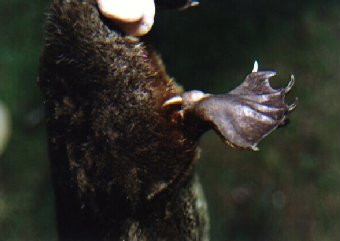
Platypuses, (not platypi) are part of a small family of mammals that includes only the platypuses and echidnas. First off: a physical description of a platypus: a platypus is an aquatic mammal; it has a duck-like bill that is completely covered in a thin layer of electro-sensitive, nerve rich skin. It has a small rodent-like body, with four webbed feet (again, more like a duck’s feet) and a flat beaver-like tail. I thought that platypuses were fairly large, but in actuality they are quite small: a little under two feet in length. They are covered in a rich brown fur that insulates and traps air much like a dry-suit or a penguin’s feathers.

Did you know (I didn’t) that the platypus hunts with its eyes closed? It gently sweeps its bill back and forth searching for an electrical signal from its prey. Once it catches its prey it then resurfaces and grinds it with its bill (as it doesn’t have any teeth).

Male platypuses have a poisonous spur growing out of the back of their hind legs. They use this when asserting dominance during the mating period and also for self defense. After the egg (yes they are mammals, and yes they lay eggs) hatches, the baby platypus/es is/are reared by its mother in a den, the mother secretes milk through pores in its belly to allow the young to lap it up. Platypuses do not have teats (these things are so weird).

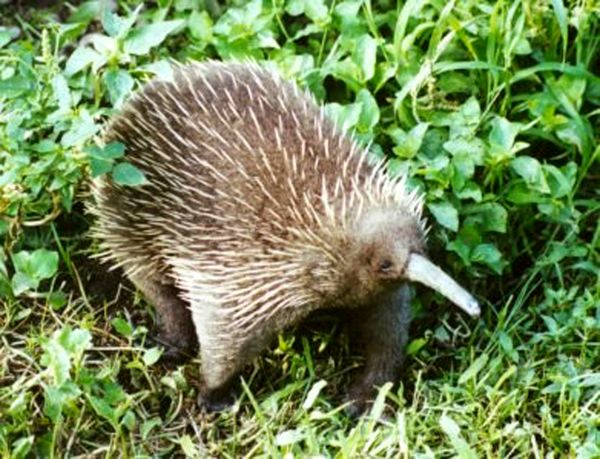
Echidnas are similar to platypuses in only the fact that they lay eggs and have electro-sensors surrounding its mouth, and the fact that they don’t have teats. They have squat hedgehog-like bodies but are significantly larger, depending on the species anywhere from a foot to a few feet in length, and growing up to about 40 pounds. They live on various types of insects (depending on the species) and have long snouts designed for that specific purpose.


      There you have it, the two most intriguing, strange, odd, wonderful and absolutely incredible creatures our God has designed.


Pics from Wikipedia.

Monday, July 2, 2012

Discovering Dingo Details


Beej Here Discovering Dingo Details
Dingo details for this article came from our experience at Healesville, their website (http://www.zoo.org.au/Healesville/Our_Animals/Dingo), and http://www.kidcyber.com.au/topics/dingo.htm and http://www.dingosanctuary.com.au/about_dingoes.htm
The pictures used in this article are ours.


Dingoes are wild dogs that live in the Australian bush and the outback areas.They are similar to Indian wolf dogs. The dingoes we got to pet were young (about 3 years old ) and one was named Tango.  Sorry- can’t remember the sister’s name.

The dingo does not have any natural predators in Australia (except humans) so they are at the top of the food chain. Some scientists believe they were brought over to Australia by seafarers from South Asia.
The dingoes move in packs and are very territorial. If a dingo moves into another pack’s territory they will start howling at each other instead of barking (as dingoes can’t bark). They do have a wide range of vocalizations from howling to yodeling, yelps, crows and purrs.

One major problem with the dingo here in Australia is that they can interbreed with domesticated dogs.  This is bad because, for some reason, this interbreeding seems to change the mindset and instincts of the animal. Instead of just killing a couple of sheep for food, the mixed breed will kill off a whole flock. It also is diminishing the line of the dingo and making a 'hybrid'. 

The dingo is an omnivore who eats mainly meat- Kangaroos, koalas, wallabies, sheep, wombats, reptiles and pretty much any meat they can catch are all on the menu. They will also occasionally eat greens and insects.

Dingoes only breed once a year, unlike domesticated dogs, which can breed twice a year. They have a litter of 5 pups usually and both parents help care for the babies. They will bring the food close to the den so the pups can ‘hunt’ for it. Dingoes mate for life.

Dingoes grow to about a foot and a half to two feet tall and about four feet long. They have course bushy coats ranging in colors from yellow to tan to brown to blackish. They have a bushy tail and large, upright, pointy ears. Dingoes are very intelligent dogs who have strong personalities and develop very strong bonds with their pack. Aboriginals used dingoes in hunting. In Aboriginal languages, they were called warrigal, noggum, boolomo, mirigung and maliki.


The up-close experience was really cool… here are some thoughts from those who got to get up close and personal with these wild dogs:


The Older thought the dingoes were extremely intelligent. He also thought it was funny that the trainer said training a dingo is like trying to train a cat. They are very independent and if you don’t have food, they really won’t listen.


Essie's thoughts: “The dingoes were pretty hyper and when one jumped up on me, it was a little surprising. I was glad I have big dogs at home so it didn’t freak me out. Their fur was soft and their tongues were tickly.”


As for me, I thought the dingo experience was extremely awesome. I think they are my favorite Australian animal… they are at the top of the food chain, just like lions on the African Savanna.


Thank you for reading this in-depth dingo discovery. Coming next…. Test your knowledge about the Tasmanian Devil.

The World's (and Australia's) Top Ten Venomous Snakes

Hello Folks,

The Older here.

I have long had a fascination with all things scaly, amphibious, or otherwise reptilian. So, when we went to the Healesville sanctuary, looking at the top ten most venomous snakes was one of my favorite things. Australia seems to have the deadliest everything around here... The world's deadliest jelly fishes... deadliest spiders... *shudders*

Sooo, I thought I would share some snakes we saw with you! :)

Images are mine unless noted.

Let's begin.
#10 The Mulga. Also known as the "King Brown Snake"


Australia seems to have trouble with it's colors and species... This brown snake is actually part of the black snake family. These guys can grow to a royal size of six to seven feet, depending on where they live. The toxins the Mulga produces are not particularly dangerous in small quantities, but when this snake bites it's prey, it releases 15x more toxin than other snakes. Their bite can kill a full grown man in 2-3 minutes. I also read that if a person remains calm until anti venom is given, they will most likely survive.


#9 The Dugite

The Dugit is a smaller snake, measuring on average 3 feet long, but has been recorded up to six feet. What makes this snake dangerous is the fact it is active in the day time, especially during the mating season when they are all Twitterpated. :P The venom is extremely concentrated, attacking and destroying basic proteins in the tissue. While this snake can kill a human quickly, the last recorded fatality was back in 1993.

#8 The Lowland Copperhead
(image from Wikipedia)


These snakes are not at all related to the American copperhead of which we all know. These guys grown to about 3-4 feet.The Lowland copperheads are extremely reclusive, only biting when stepped on or dug out of their den (don't really know why you would be doing that... Anyway) Their fangs are very short, so boots and thick pants often provide protection from the bite. If one is bitten however, they will die unless anti venom is provided promptly afterwards.

#7 The Gwardar

The Gwardar is a member of the brown snake family, and is about 3 feet long. These are very fast and quick snakes, active and hunting during the day. The fangs of a Gwardar are very small, equaling a painless bite. Often people are bitten without ever knowing it. First aid is easily applied to counteract the venom, but since people often don't realize they have been bitten, it is usually administered to late.


#6 The Common Death Adder

I will be honest, I think Death adders are some of the coolest looking snakes out there. These short and squat snakes are rarely longer than 3 feet in length. The are not the most agile either, preferring to sit and wait for prey instead of hunting it. Their fangs some of the longest of any known snake, second only to the tapian. This makes their bites quite painful. The adder accounts for the majority of snakebites, since it doesn't flee from humans, preferring to stay and fight. The venom attacks the central nervous system of its victim, causing near immediate muscle paralysis, the diaphragm and lungs to cease to function, then death as the toxin destroys the cerebral cortex. Although that sounds pretty awful, the ratio of bites to deaths is very low. About 8 in 100,000 people bitten die. It all depends on how much venom the adder is able to inject.


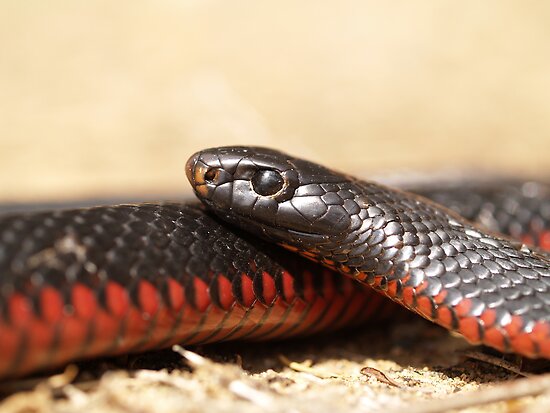
#5 The Red Bellied Black snake
Image from skyscrapercity.com/forums


The red bellied black snake is one of the most distinguishable of the 10 deadliest snakes. It is very docile and will rarely bite a human. When it does hoever, the venom can be lethal, but there is not one recorded instance where a human has died from a bite from this snake. The reason for this is most of these guys live in urban gardens, so first aid can be applied quickly and effectively. In the wild, you will rarely find one, as they flee at the first hearing of footsteps.


#4 The Tiger Snake

The Tiger Snake is one of the hardest snakes to identify out of these ten, as the colorings vary from black, to brown, to yellow, and even olive. The stripes vary in those colors too. Tiger snakes grow to a size of 6-7 feet long and are not usually aggressive, though will bite if they feel threatened. While death does occasionally occur, the venom is more known for the causing immense amounts of tissue damage and causing kindey failure. The venom is slow moving, so easily containable around the bite, so as long as first aid is applied immediately, one will not die.

#3 The Costal Tapian

The Costal Tapian is number three on the world's deadliest snakes list for good reason. This snake is active during early morning and extremely fast. They can grow to about 6 feet, but the standard size is around 4 feet. What makes this snake so deadly is the fact when it is hunting or defending itself, it will strike not once, but 3-4 times in less than a second. Then it flees to a safe distance and lets it's victim die. Death for a rodent is near instantaneous, and a human will die in about 30 minutes if not treated. The mortality rate upon being bitten with treatment is 90%... The reason for this is the venom is a neurotoxin, attacking the brain and spine without bothering the lesser nervous systems.

#2 The Common Brown

Common brown snakes grow to about 4 feet long, and are found mainly in woods, grasslands, and urban areas. This snake alone accounts for about half the deaths that occur by snake bites, because  it lives in close proximity to humans. When biting, these snakes can lunge several feet, then retreat quickly after giving said bite. When Anti-venom is applied, the victims usually survive. However, because of the fast clotting and aggressive venom, usually more than one dose must be applied. Most deaths are caused by the venom reaching the brain and causing internal bleeding and hemorrhaging. About 5 deaths a year occur due to this snakebite.

#1 The Inland Taipan
image from funpicland.com

The world's most venomous snake, and native to australia, grows to be about 5 feet long. While the venom in this snake is potent enough to kill over 250,000 mice in one bite... There has never been a recorded death of a human by this snake. The reason for this is it is extremely shy and reclusive. It also lives in the middle of Australia, as opposed to the coast. The middle of Australia is arid and sparsly populated, so people do not often encounter this snake. So while it's venom could kill a human in as little a 15 minutes, it is not one that has ever killed a human.


So there you go! The 10 most venomous snakes in the world... living in Australia. Hope you enjoyed it and learned something! :)

Compelling Kangaroo information


Beej here reporting compelling kangaroo information.

This information is from the Healesville sanctuary, our awesome handler Lulu and their website http://www.zoo.org.au/Healesville/About/Our_Animals and www.reptilepark.com.au, or www.tourkangarooisland.com.au but all the pictures are ours.

There are 63 different types of kangaroo and all except the tree kangaroo are native to only Australia. There are four main species that are commonly called kangaroo. These are:

The Red Kangaroo- Their scientific name is Macropus rufus. This is the largest marsupial in the world and the most common in Australia.

The Eastern Grey Kangaroo -Their scientific name is Macropus giganteus. This species ranges over the fertile eastern part of the continent.

The Western Grey Kangaroo there scientific name is Macropus fuliginosus. This species is found in the southern part of west Australia, near the coast of south Australia and the Darling River basin.

The Antilopine Kangaroo there scientific name is Macropus antilopinus. This species is found in the far north of Australia. They inhabit grassy plains and woodlands.

One weird thing … Red kangaroos are often gray and Gray kangaroos are often red, bluish, or brown.


Some subspecies of kangaroos are: Wallabies, Quokkas, Musky-rat kangaroo (the smallest type of kangaroo), Tree kangaroos. Some more subspecies are the Pademelons, Wallaroos and Euros, Rat-Kangaroos (which look like giant rats), Potoroos and Bettongs (which usually weigh only a couple of kilograms when mature).

Tree Kangaroos are my favorite sub-species. 

They live in trees but can easily jump to the ground from 6m (which is approximately 20 feet for us Americans) up and escape along the ground if threatened. There are numerous species of tree-kangaroos. Fun Facts: Tree kangaroos don’t use their tails to swing or climb. Tree kangaroos have strong forearms, unlike regular kangaroo.


There was a mama Red kangaroo named Rosy, who had a baby boy Joey in her pouch (he didn’t have a name yet). Can you see his little head sticking out? We didn’t get to feed her. And notice...although she is gray in color, she is a red kangaroo- go figure?


We were blessed to pet and feed Kangaroo Island Kangaroos. Their scientific name is Macropus fuliginosus as they are a subspecies to the Western Grey Kangaroo. And yep, they are reddish brown grey kangaroos- it cracks me up! Kangaroos can’t swim at all so they were stuck on the island when it separated from the mainland. Their fur is dark brown and is thicker than other kangaroos and they have big black claws and paws. I think this one's name is Heidi.


The Kangaroo Island is a large grassland with shrubs and trees. The kangaroos graze in the early morning and late afternoon. Their diet is grass, herbs, and leaves. They have a chambered stomach like a cow, so they eat, spit up the food and then chew on it for a while before they swallow it for good. Pretty gross actually.


The kangaroos mobs

(the name for a group of kangaroos) have a hierarchy including the head or the alpha male that will fight for his position if challenged. Bucks are usually able to gain this position from the age of 5-7 and can hold it for 4 years or so. Check out the claws on Trevor below! They were much bigger than the female's claws. We were also not allowed to feed him!


Female Kangaroos around the age of two can begin having babies. They usually birth one joey at time and it is kept in the pouch until about 6 months then the baby will move in and out of the pouch until he is about 9 months to a year.  He will still nurse for about 6 months, but now a new joey can be born. Joeys are born after 35 days and are about the size of a jelly bean. They don’t have hair or eyes or really anything except little arms. They use the arms to pull themselves into the pouch where they begin nursing and that’s all they do for the next 6 months.
Some cool fun facts: Mothers can produce milk of different nutritional values at one time. 
Joeys always nurse from the same place, so the younger and older joeys always get just the right milk. 
Females are able to put their pregnancy on ‘hold’ (called Embryonic diapauses). How crazy is that!?!? They do this in drought conditions or if there are already multiple joeys nursing.

At around a year the male joey will begin practicing boxing with his mother.  So eventually she has to run him off. The girl joeys often develop a strong bond with their mom and can remain close throughout their lifetime.


Kangaroos are not monopods (Reference ‘Voyage of the Dawn Treader’) but they are macropods. This means that they have big middle toes, making them have an extra big foot. They also have to move both of their back legs at the time. Who knew?
 But this doesn’t slow them down! They can jump 4-6 meters (13-20 feet) go 60kph (about 40 mph) for an extended time. Their jumps can be 3 meters high (about 10 feet)


Their tails are used for balance and steering, and occasionally boxing. Males can lean back on their tails for a minute and kick the other kangaroo. The tail is also used when the kangaroo is moving slowly. The spine runs all the way down through their tail. Here's Rosy again, sorry, but this was my best picture of a kangaroo resting on the tail.


Essie loved petting and feeding the kangaroos. Here what she had to say:
“I learned that baby joeys stay in the mum’s pouch for 6 months and then they start coming and going. They drink milk for about 8 months to a year. We only got to feed the girls because Trevor, the boy, had huge claws and could get in a fight. We fed them leaves and corn and carrots, which were special treats.  Sometimes they took the food with their mouth, and sometimes with their claws… but don’t be afraid because they took it gently.  And then they spat it back in their mouths and re-chewed it later.  I also learned that they have a spine all along their tail, so you have to be careful not to step on their tails or you will break it. Sometimes they crawl (when they go slow, they have to use their front legs) and other times they bounce. They have to hop with both back feet together (their back legs can’t move independently) and Kangaroos can’t go backwards.  They have very soft backs but don’t like you to pet their heads- especially their ears. “


Be back soon with breaking Dingo news... Beej

Healesville Animal Sanctuary


One rather chilly, drippy day in Southern Australia, the clan went to see some amazing things at Healesville Animal Sanctuary. WE love zoos (!), but this was a sanctuary, not a zoo. Only indigenous animals are here and they were in a very natural habitat!


Everyone here is so friendly and Robin at the ticket counter was no exception! She helped us choose what we wanted to do, got our schedule plugged in and helped us figure the most cost effective way to get it all done. She ROCKED!


To say the sanctuary was beautiful would be an understatement.  Unusual bushes, and up to 200 year old trees ...


And the animals we were able to see were also amazing… 


Koalas- cute but boring, just slept the whole day! 


Emu- they made a weird low grunting noise that sounds like a pig!


Tasmanian Devil- did you know they have developed a facial tumor disease that is threatening their entire population?


Dingos- wait till you see the upcoming dingo experience Essie, The Older and Beej had!


.


Lots of amazing birds


An incredible bird show- and Essie had a special guest sit with her for part of the show. Many wild ibis roamed the sanctuary... they were pretty noisy, even during the bird show. 


And of course kangaroos! We were able to feed and pat the kangaroos- see Beej’s upcoming post for more Roo information.   We learned so much!!!  


Lunch was yummy (and very affordable) meat pies with chips!


We got a little wet and a little chillier as the day progressed, but the animals didn’t mind and we were able to hide from the rain in the platypus and reptile house. The Older will fill you in on the snake info in the next few days. The platypus house was totally dark, so sorry, no pictures. These little freaks of nature certainly verify that our creator has a sense of humor. It looks like there were a few spare parts at creation and God just stuck them all together. The Tall One is going to post a platypus exposé shortly. So stay tuned…. We had a great time this weekend, can’t wait to sort through all the pictures and get the posts ready to share with you. Please forgive us for the delay in posting and the odd stretchy look of some of the pictures.  We are having a few computer picture issues...

The Older wrote his own post on his blog www.theramblingstone11.blogspot.com  so check it out. I actually think it turned out better than our collaboration here... :)

Praying for you as you suffer through the hot dry weather there!